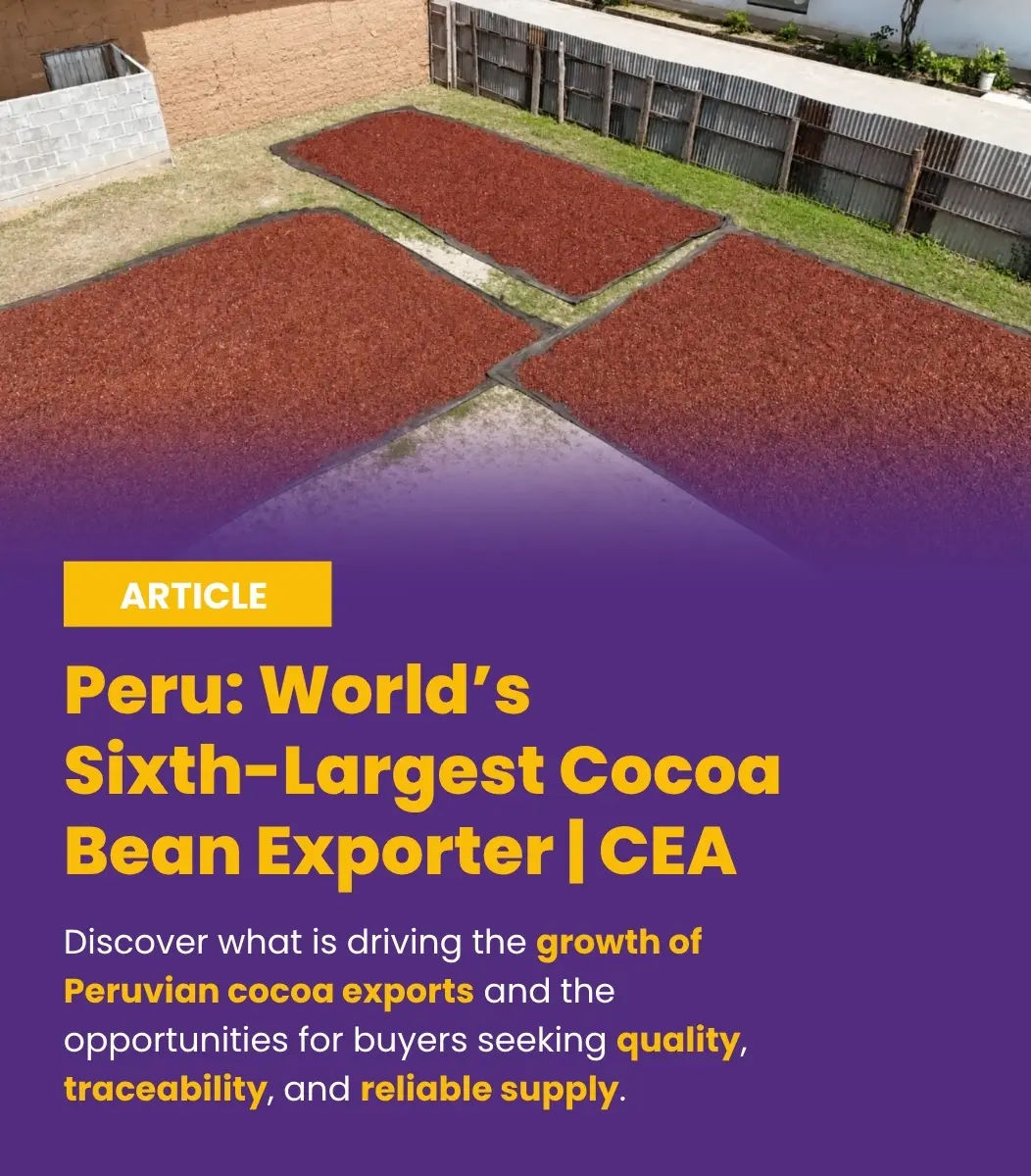
Peruvian cocoa continues to gain ground in the international market. In 2025, the country reached a new milestone, consolidating its position as the world’s sixth-largest exporter of cocoa beans and the second-largest in Latin America, according to Peru’s Ministry of Foreign Trade and Tourism (MINCETUR).
Beyond the ranking itself, this progress reflects the growing presence of Peruvian cocoa in a market where quality, traceability, and the ability to ensure a consistent supply are becoming increasingly important.
Growth that is also reflected in exports
Between January and November 2025, Peruvian exports of raw cocoa beans exceeded US$876 million, representing a 25% increase compared with the same period of the previous year, according to the Ministry of Agrarian Development and Irrigation (MIDAGRI).
By the end of the year, the sector was projected to reach approximately 112,000 metric tons in exports, representing growth of nearly 16% in volume.
Peruvian cocoa is also continuing to expand its international reach. During 2025, cocoa and cocoa-derived products reached more than 70 international markets, strengthening Peru’s presence among buyers with different sourcing requirements and supply profiles.
However, this performance is not driven by a single factor.
What is driving the growth of Peruvian cocoa?
Part of this growth is linked to the international market environment. The decline in global supply, mainly due to production challenges faced by Côte d’Ivoire and Ghana, placed pressure on global cocoa availability and created new opportunities for other producing countries.
However, Peru’s growth is also supported by capabilities developed throughout its own cocoa value chain.
A broad production base
Cocoa production extends across 16 regions and involves nearly 100,000 small-scale family farmers. San Martín, Junín, Ucayali, Huánuco, and Cusco account for approximately 86% of the country’s total production.
A differentiated origin
Characteristics associated with the quality, aroma, and diversity of Peruvian cocoa have helped strengthen its recognition among international buyers seeking products with specific attributes and identifiable origins.
A more market-oriented value chain
Collaboration among producers, organizations, companies, and institutions continues to strengthen capabilities related to market access, quality, and compliance with international market requirements.
This combination of favorable international conditions and a production chain that is increasingly capable of responding to market demands is allowing Peru to gain greater prominence as a cocoa origin.
What does this scenario mean for buyers?
For international buyers, the growth of Peruvian cocoa represents an opportunity to diversify their sourcing strategies and explore commercial relationships with an origin that continues to expand its global presence.
However, greater volume alone is not enough.
In an increasingly demanding international supply chain, factors such as consistent quality, traceability, origin, compliance with standards, and supply reliability are key when selecting a supplier.
Therefore, the real challenge for Peruvian cocoa will be to transform this growth into sustainable commercial relationships capable of consistently meeting buyers’ needs and maintaining long-term confidence in the origin.
From Peruvian origin to international markets
At CEA, we work to connect Peruvian cocoa with international markets through a value chain focused on quality, traceability, and the development of long-term commercial relationships.
Peru’s growth is opening new opportunities for the industry, but consolidating its international position will depend on the entire value chain’s ability to maintain what markets demand today: consistency, transparency, and trust from origin to buyer.
Learn more about CEA and our cocoa offering for international markets.
Learn more: cea-latam.com